The Semiquincentennial (250-year anniversary) of the United States of America offers a potent opportunity for reflection and discourse. At the signing of the Declaration of Independence in 1776, the territory which constituted these new “united states” only accounted for a small fraction of the land the modern American Empire occupies today. These lands, which have held and nourished generations of peoples for much longer than a quarter millennium, are under imminent threat in myriad ways. From questions of property, ownership, and legacy to notions surrounding extraction, cultivation, and exploitation, the artists in this exhibition offer counter narratives to a monolithic story of America. These stories give a new shape or volume to the way we understand the construct of America. Not only in ideas of containment and expansion, but in terms of weight of what is held in the energies embedded in land and in clay.
Detroit, a city that has been shaped by cycles of migration, extraction, and reinvention, offers a critical lens through which to examine the American narrative. Through layered histories rooted in land, labor, and legacy, Detroit mirrors some of the broader questions posed by this exhibition. What histories lie beneath the surface of the land we occupy? How do inherited stories of land and loss shape cultural identity and belonging? How do we reckon with the land not as a possession, but as a witness? The forces that have pressed upon Detroit are both visible and embedded, forming volumes of memory, resistance, and transformation. In this way, Detroit becomes more than a setting; it too becomes a vessel, holding the tensions and possibilities that define a 250 year experiment.
This exhibition was curated by Quinn Alexandria Hunter and Bri Murphy.
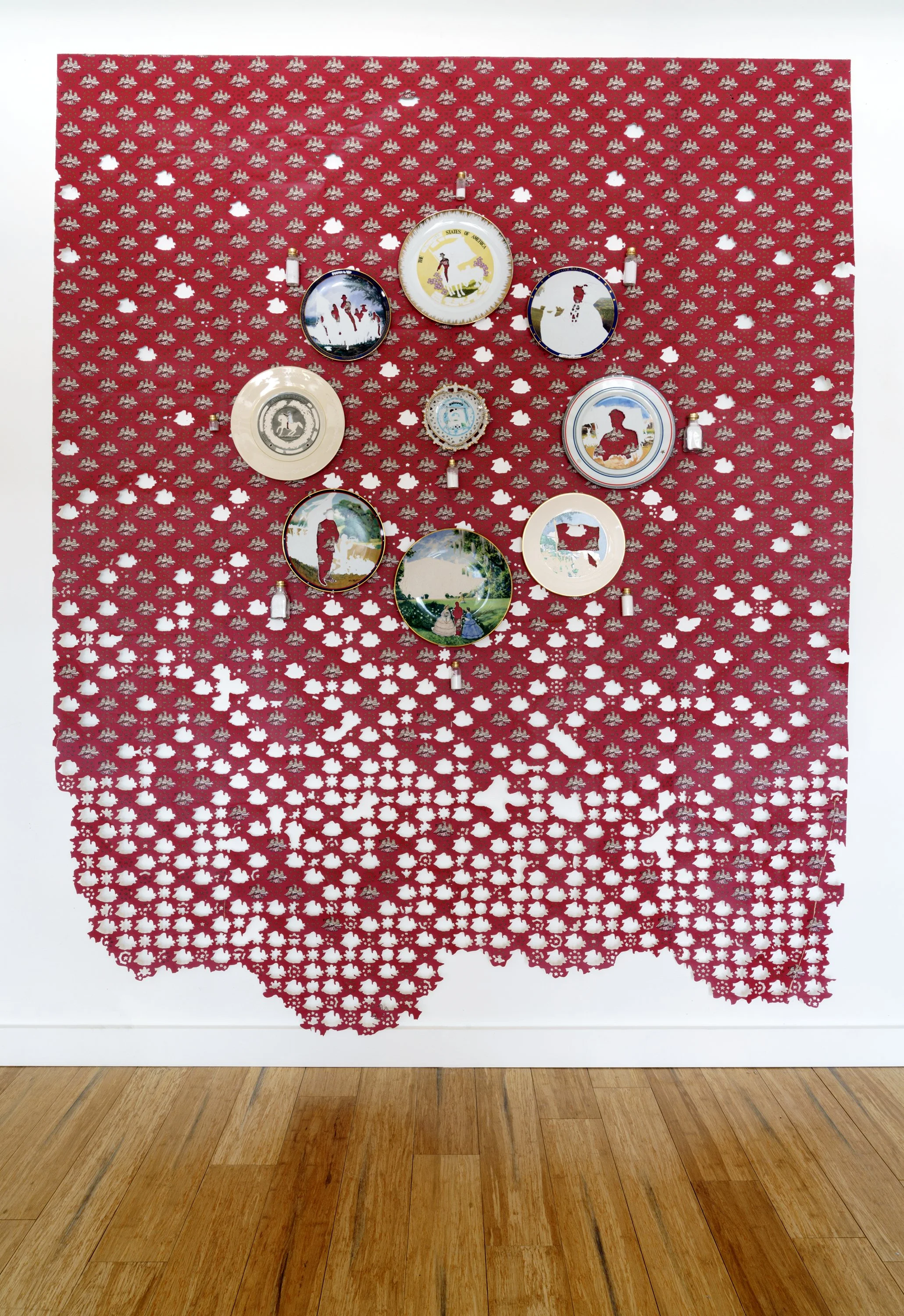

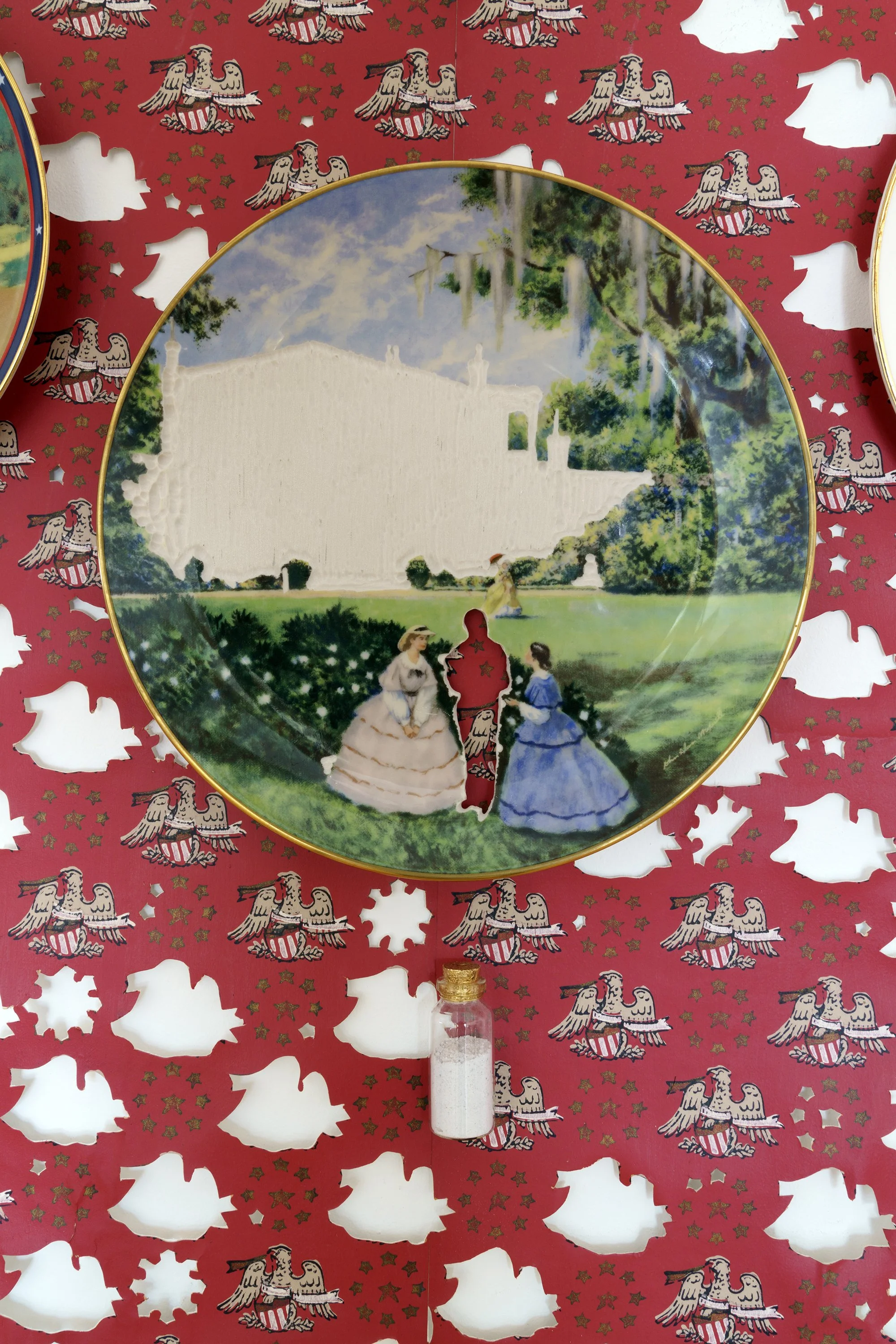
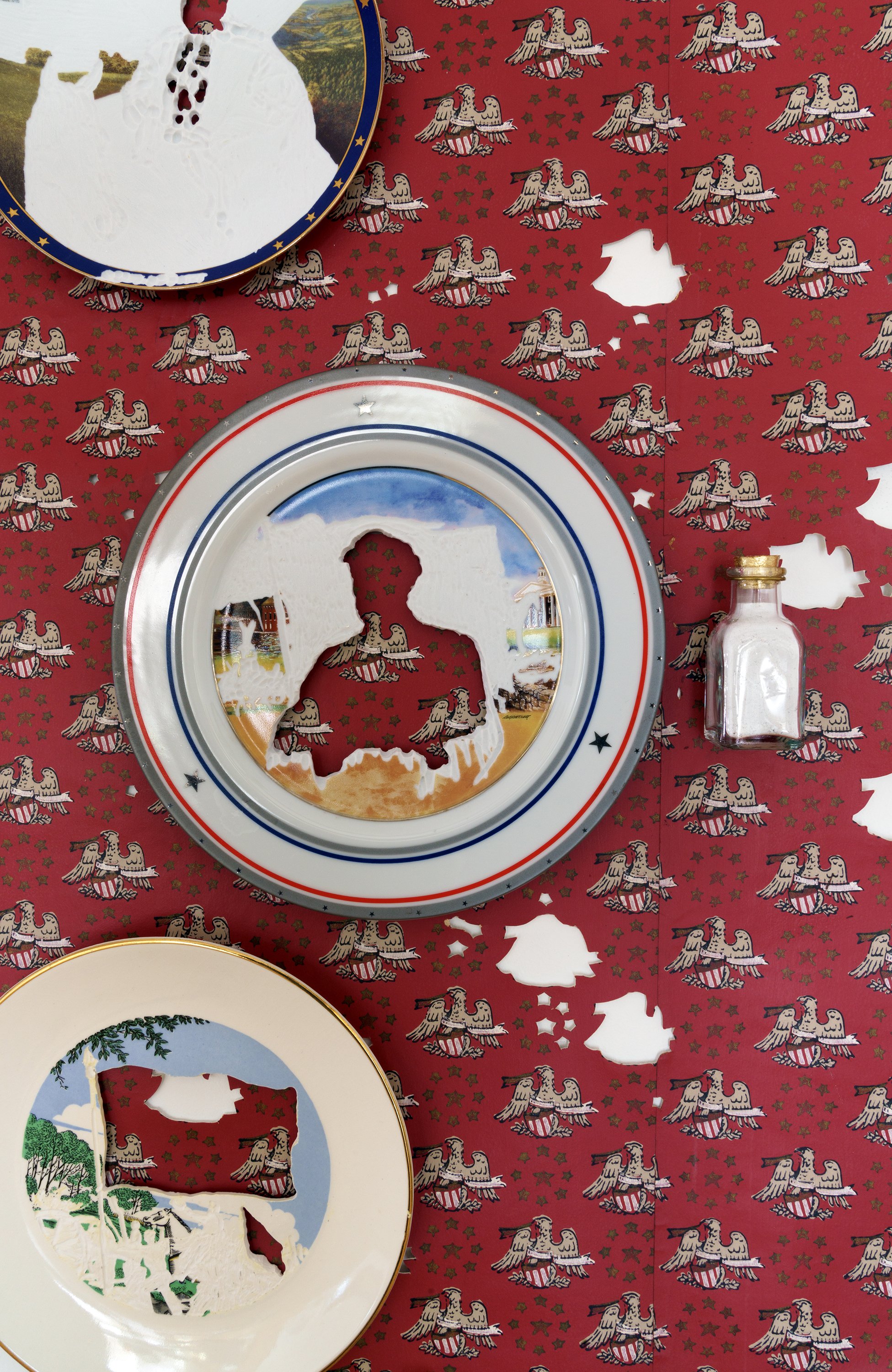
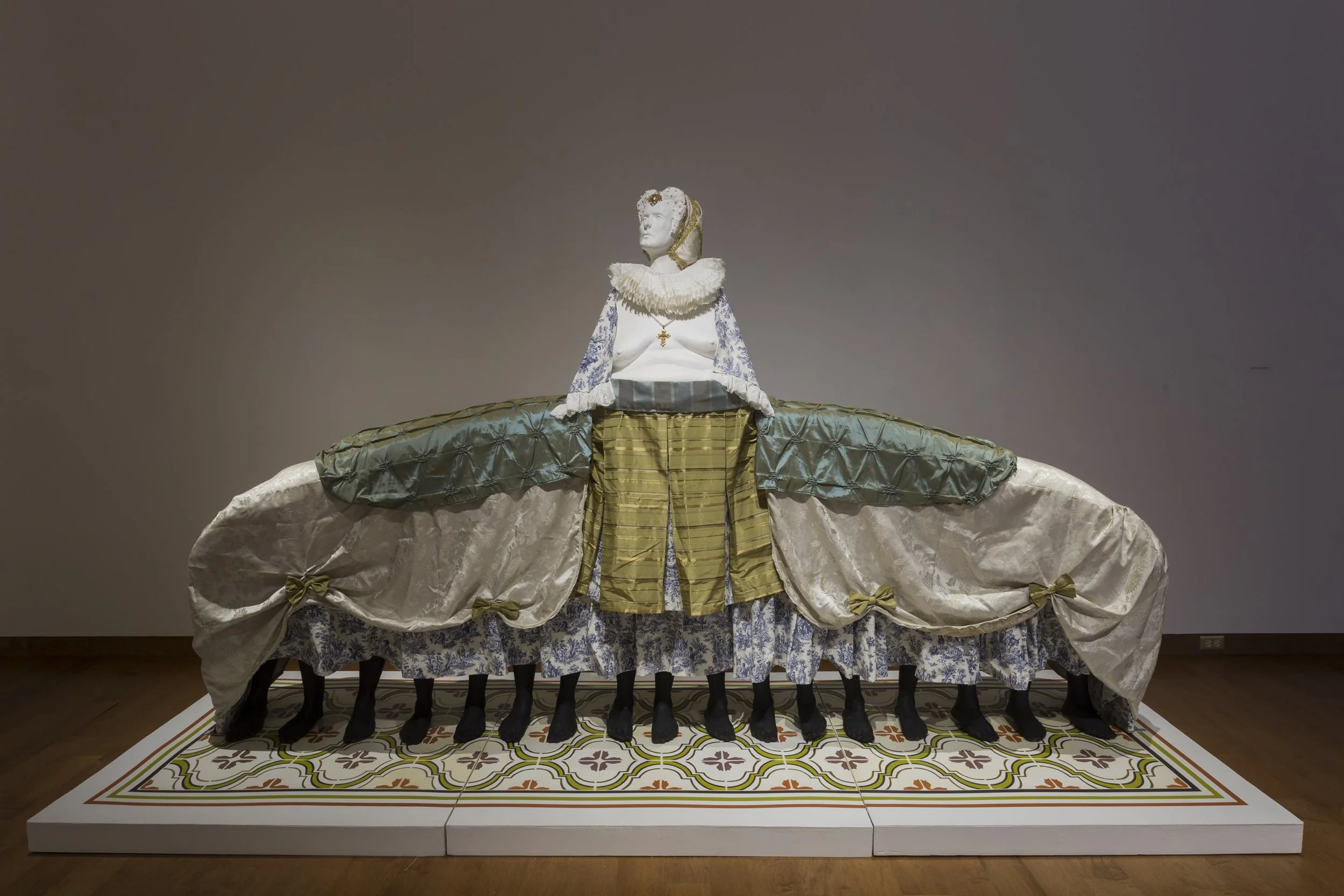
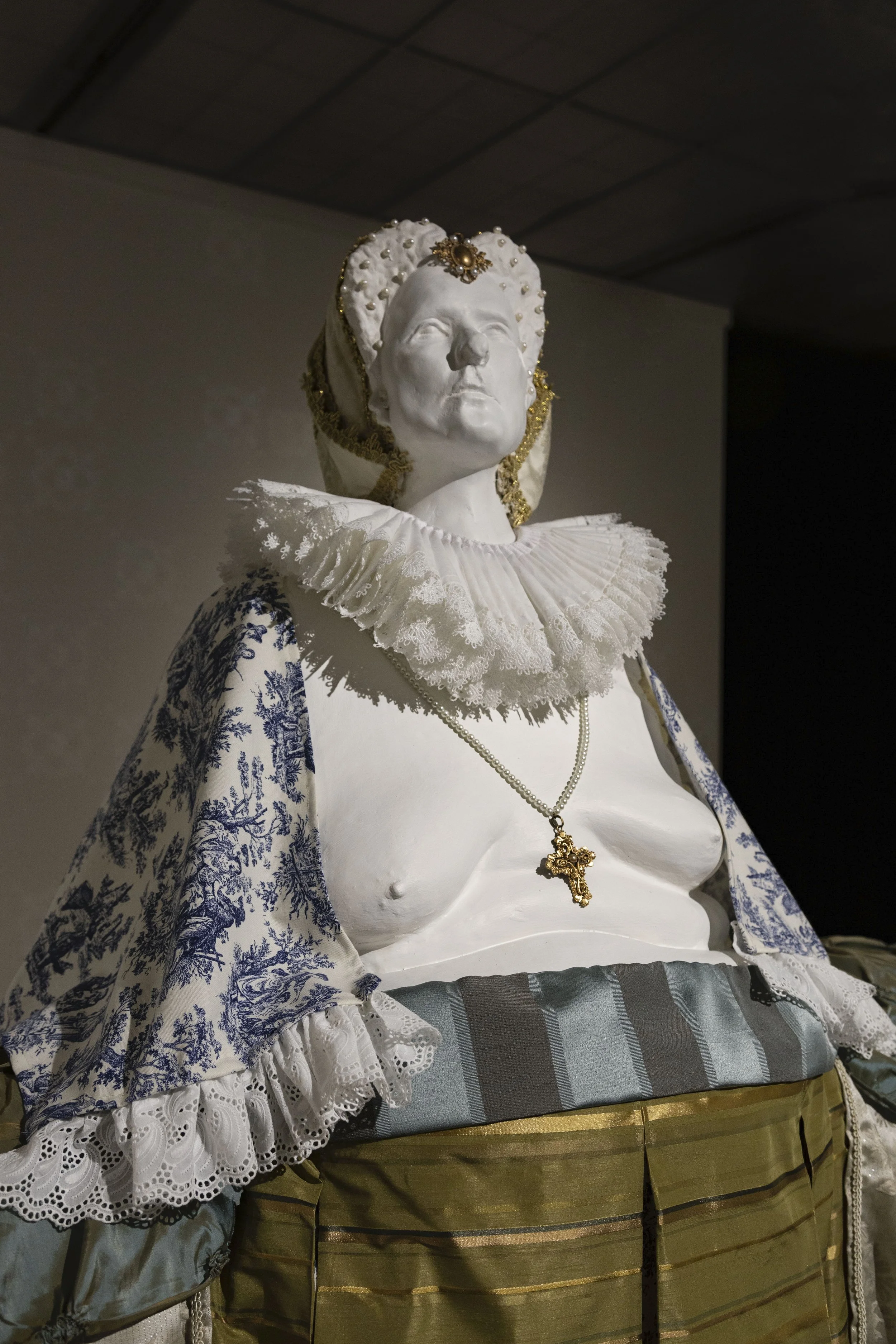
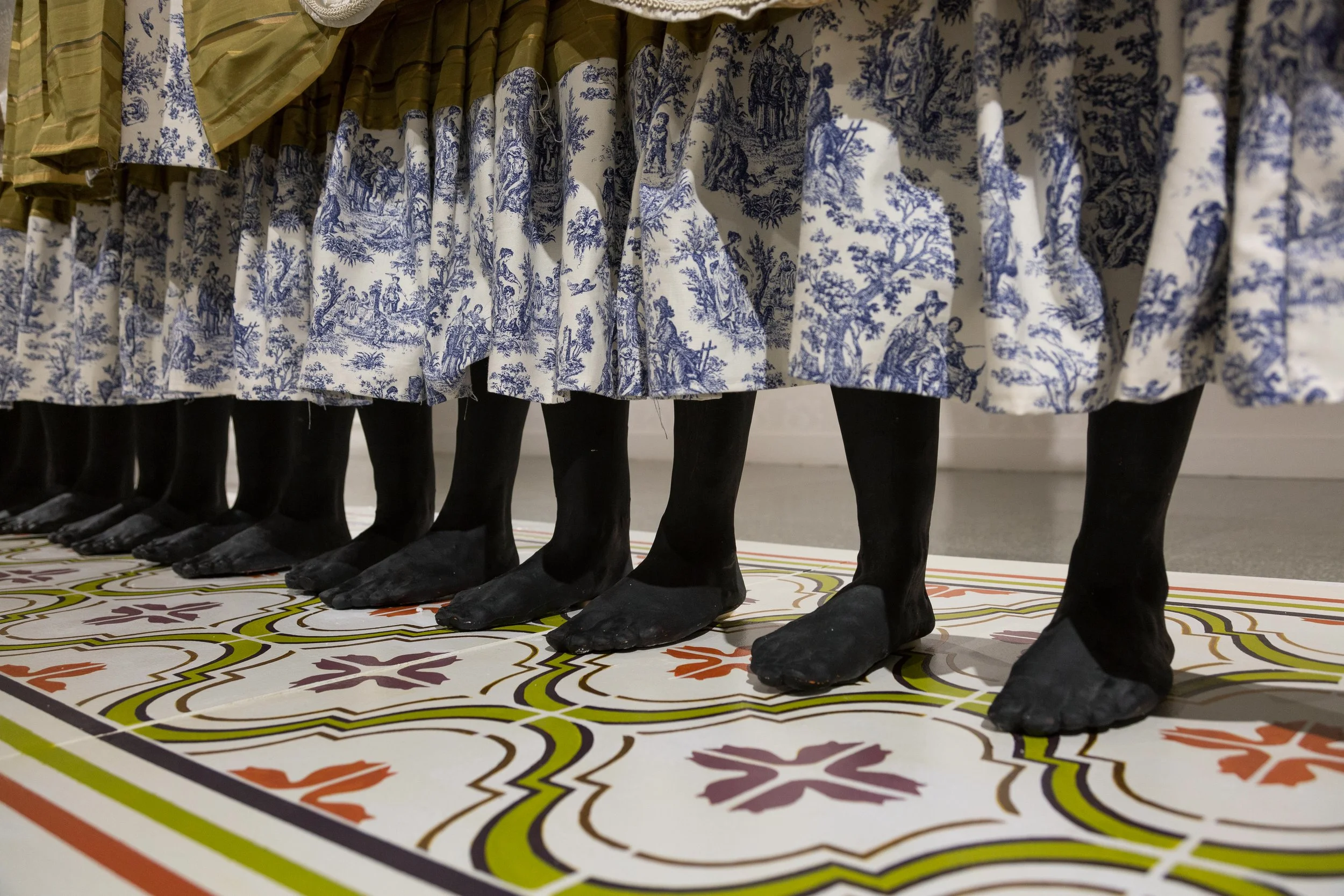
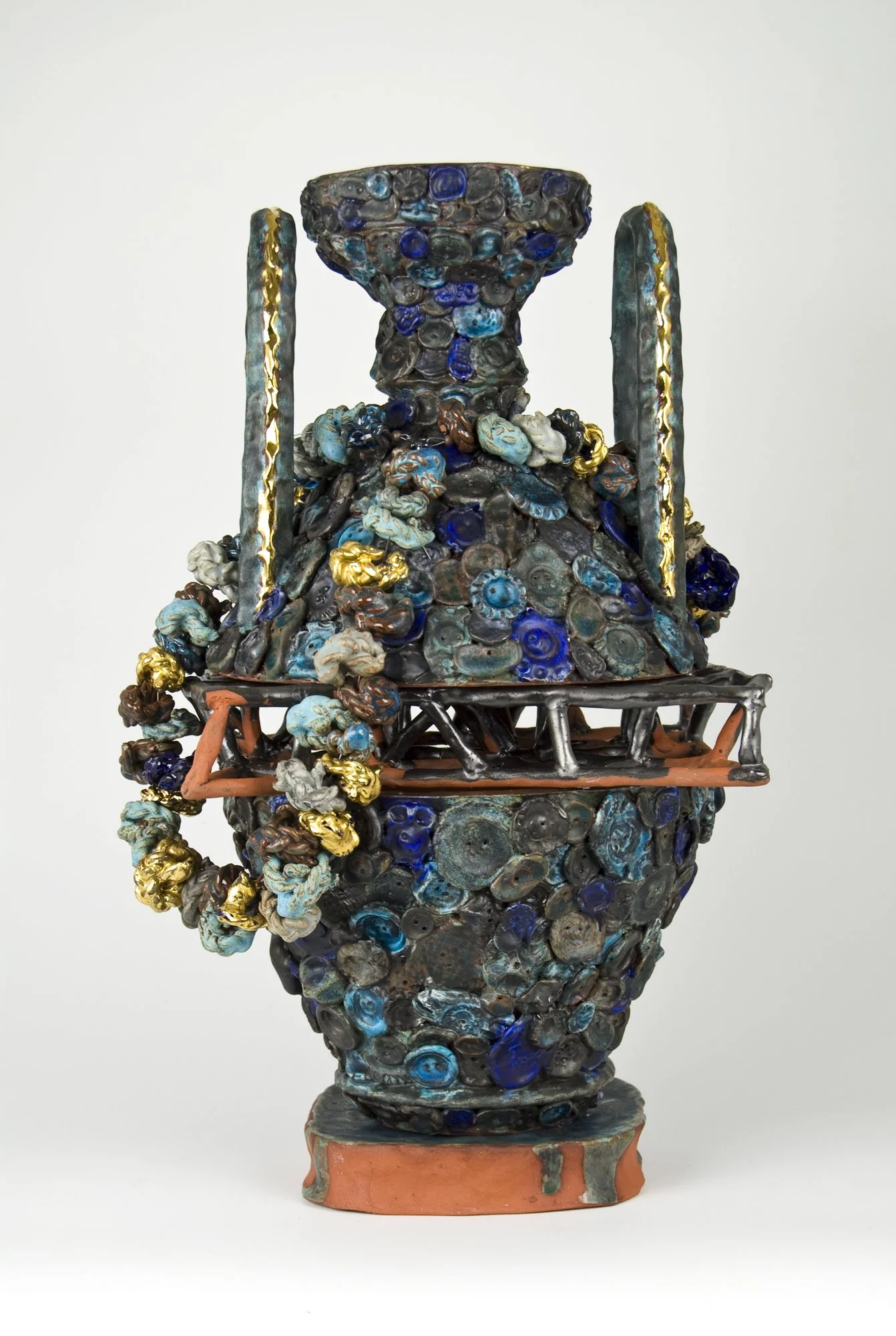
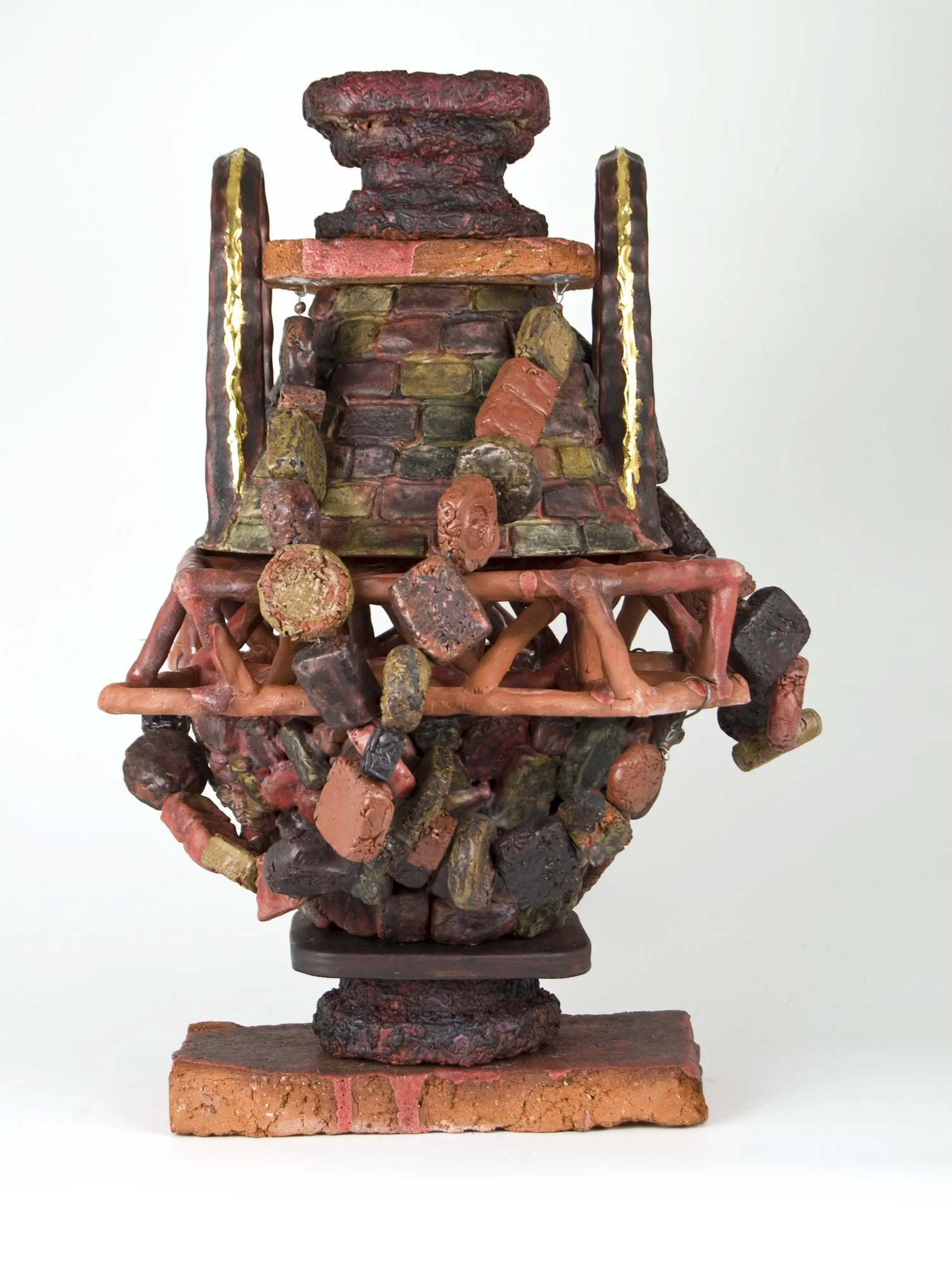

Artist Statements and Biographies
-
BIOGRAPHY
Elizabeth Alexander, b. 1982, is an interdisciplinary artist specializing in sculptures and installations made of deconstructed domestic materials. She holds degrees in sculpture from the Cranbrook Academy, MFA, and Massachusetts College of Art, BFA, where she discovered the complex nature of dissecting objects of nostalgia. Alexander’s work has been exhibited at institutions across the country including the Museum of Art and Design, National Museum of Women in the Arts, North Carolina Museum of Art, Southeast Center for Contemporary Art, and Nasher Museum. Her work is included in permanent collections at the Crystal Bridges Museum, the North Carolina Museum of Art, Fidelity, and the Mint Museum. The National Museum of Women in the Arts included her work in the ‘Women to Watch” series. Alexander has been the recipient of awards from the Harpo foundation, the Society of Arts + Crafts, Blanche E. Colman foundation, Massachusetts Cultural Council, and a Burke Prize nominee by the Museum of Arts and Design. Her work has been included in publications such as Hyperallergic, The Denver Post, the Boston Globe, Galerie Magazine, and the Modern Art Notes Podcast. She is represented by K Contemporary. Alexander is currently an Associate Professor and Sculpture Department Coordinator at Montserrat College of Art in Beverly, MA.
ARTIST STATEMENTCountering the idyllic image of the unblemished American home, Elizabeth Alexander engages in purposeful acts of deconstruction and renovation that expose pervasive chaos embedded in our shared humanity. The shape and scale of the work ranges from small sculptural objects such as a disassembled teacup, to photographic prints of altered environments, to site-specific installations with sound and performance. She frequently uses common household materials and motifs, along with familiar objects cast in paper, to unpack social, cultural, and psychological pressures that complicate American ideals for domesticity, success, and safety.
Once coveted symbols of beautification and success are appropriated, edited, and rearranged to explore ways seemingly docile items within the home quietly signal all manner of dangerous values and power structures, and how one might be unconsciously operating within these systems. From a stock of thrifted items, the domestic becomes raw material, and she harnesses the symbolic weight and history these items carry.
Alexander’s interest in exploring American values and the idealism of home stem from a loving yet tumultuous working-class upbringing where her home and the surrounding outdoors were at the center of her world. Home is a place that is shaped to hold and mirror our stories, and to witness, and hide our secrets. It is the place where hidden pressures, values, and power structures are taught, enacted, and reinforced. It is where we seek shelter from the elements, yet it is also where one’s security can turn on a dime caused by any number or forces. In what she refers to as ‘beautiful disasters’ she works to envision the vulnerability within our surroundings, uncover the porousness of our walls, and questions the sanctity or dependability of this material symbol.
-
BIOGRAPHY
Magdolene Dykstra is a second-generation Egyptian Canadian artist educator. After studying both biology and visual arts in undergraduate studies, she earned her MFA from Virginia Commonwealth University. Her work in sculpture, installation, and mark-making is grounded in exploring systems of relation, anti-capitalism, and craft. Magdolene has participated in residencies at the Medalta Historic Clay District, Watershed Center for Arts and Crafts, and Concordia University. Magdolene has been awarded several grants from the Ontario Arts Council and the Canada Council for the Arts, including Research and Creation Grants, Exhibition Assistance Grants, and Arts Abroad Grants. She has been recognized by the National Council on Education for the Ceramic Arts as a 2024 Emerging Artist and received the 2024 Helene Zucker Seeman Fellowship for Women. Her work has been exhibited in museums and galleries in Canada and the US. Notable exhibitions include site-specific installations at the Gardiner Museum (Toronto, ON), Canadian Clay and Glass Gallery (Waterloo, ON), and the Art Gallery of Burlington (ON), as well as solo exhibitions at the Jane Hartsook Gallery (New York, NY) and A-B Projects (Los Angeles, CA).
ARTIST STATEMENT
Dismantle. Reimagine. Rebuild.
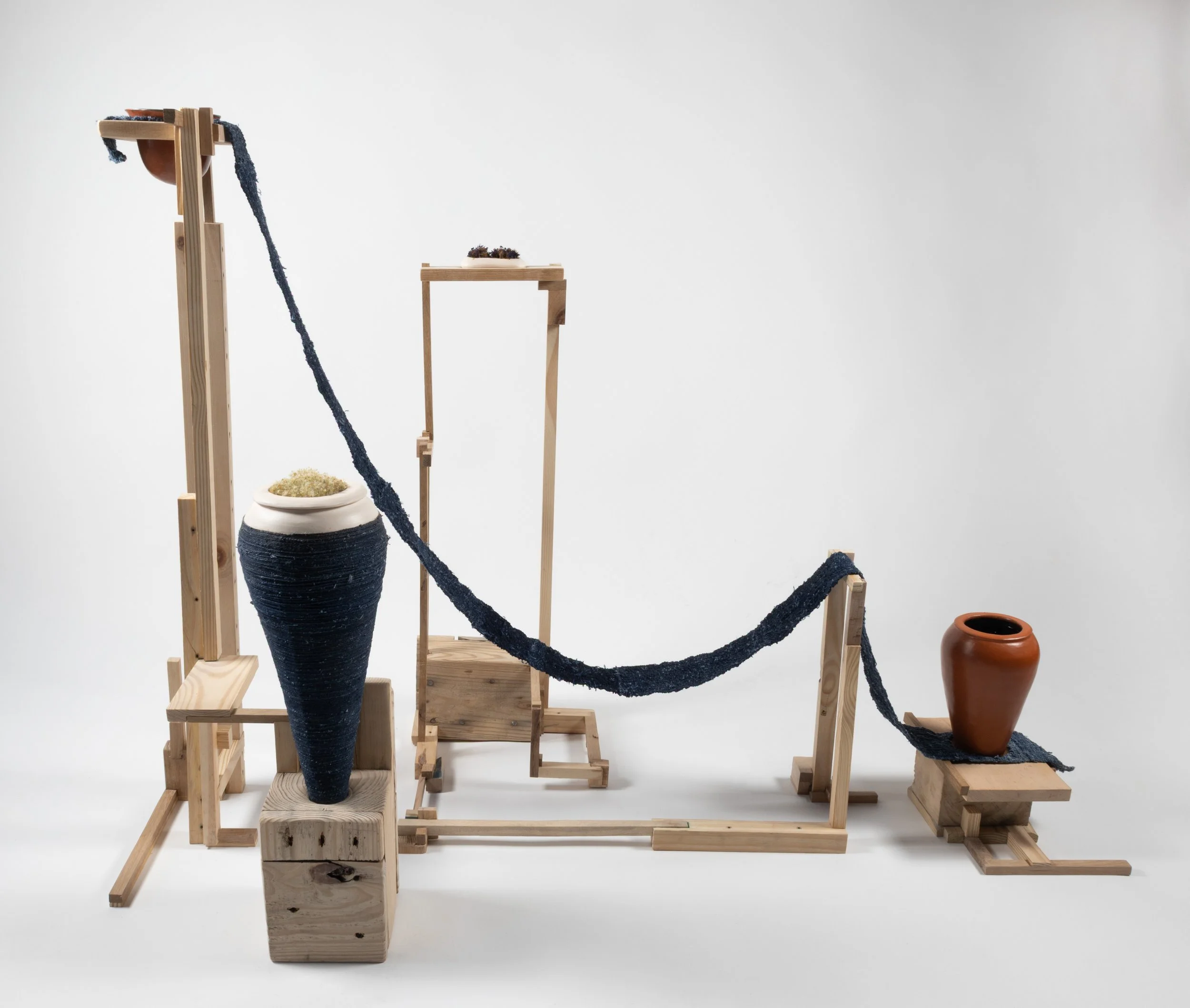
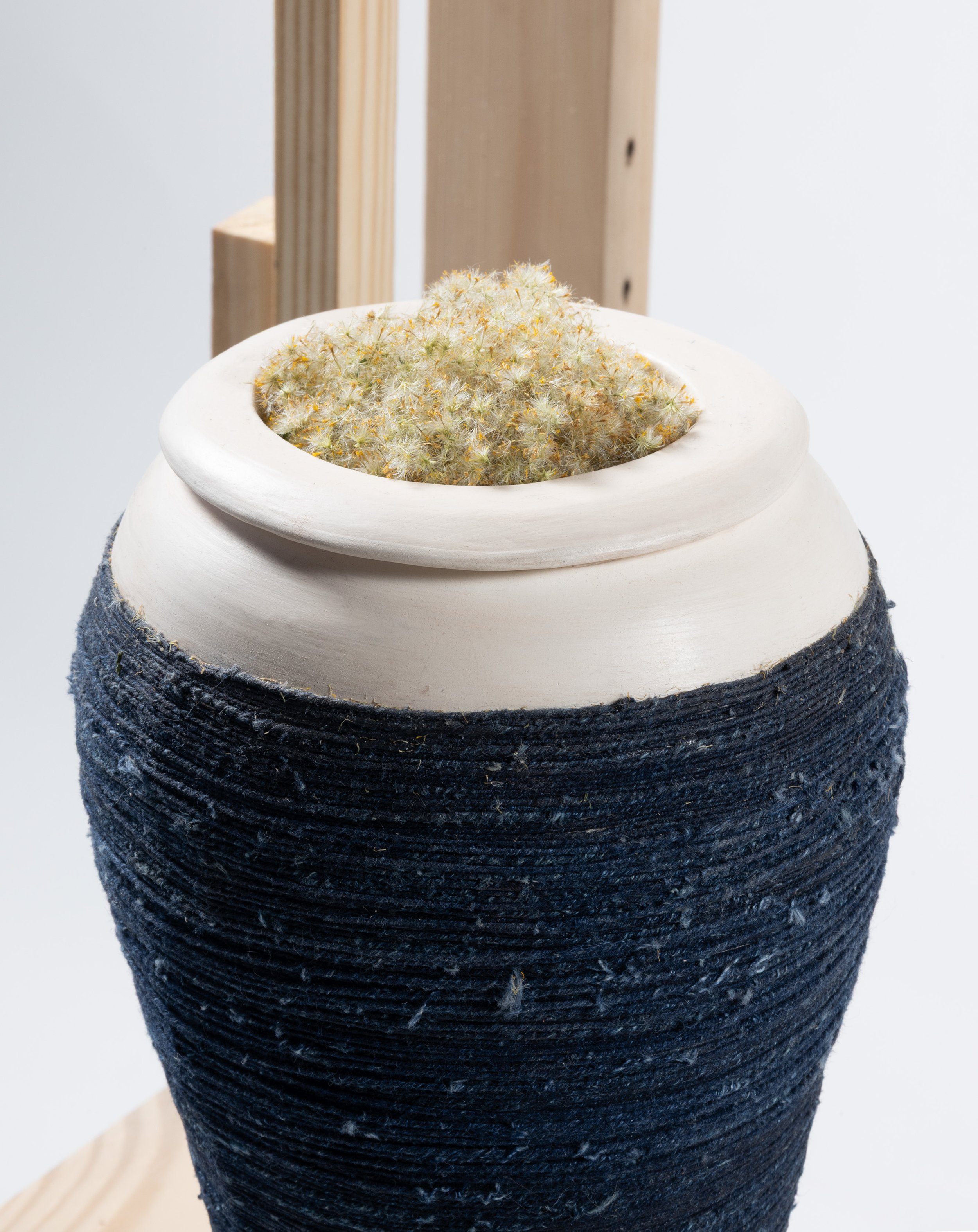
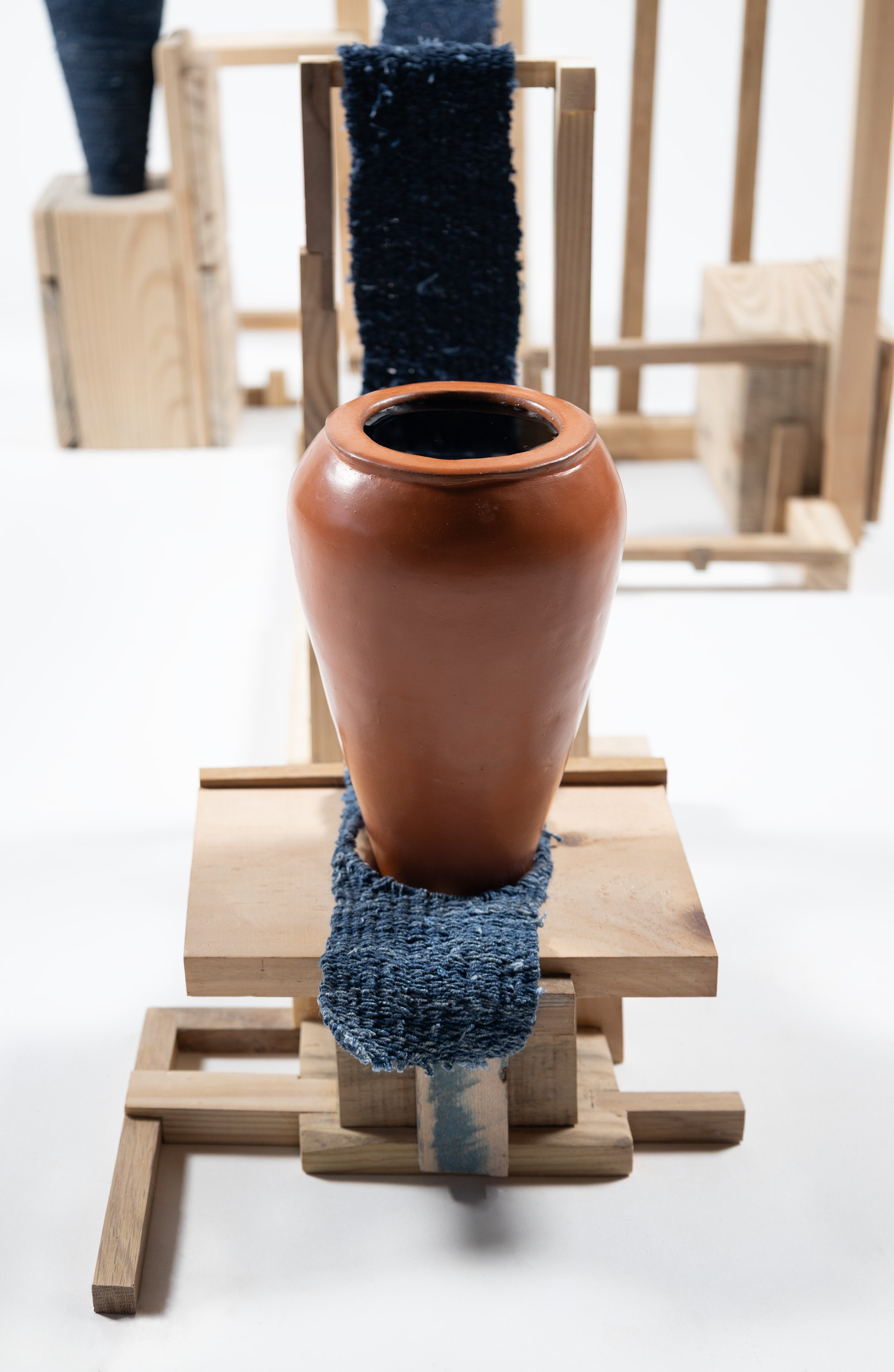
Speculative Structures uses processes of undoing, reimagining, and reforming to manifest arrangements where each part holds and is held. To create these assemblages, I dismantle structures entangled within a network of exploitative capitalism, including shipping palettes and discarded clothing. This allows for material reconfigurations driven by principles of mutuality, care, and collectivity. Objects made of reclaimed clay reference rituals dedicated to transformation practiced by my Egyptian ancestors and reforges a connection to my heritage. These materials, fiber, clay, and wood, bear the residue of people and place, global trade and the touch of laborers worldwide. In contrast to the extractive systems in which they have travelled, realigning these materials one relationship at a time conjures a gentler way of being with the living and non-living bodies around us.
Speculative Structures emerges from the intersection of my personal history and a committed belief in the possibility of systemic transformation. This work is rooted in critiques of the systems within western society that propose and uphold firm boundaries between valuable and disposable, self and other, human and non-human beings. Speculative Structures operates in opposition tocapitalism’s insistence on hyper-productivity, easily consumed products, and hierarchies of value. I adopt processes that insist on slow transformation and relationship-building as modes of resistance. I embrace improvisation and material experimentation as a means of courting possibility while challenging notions of right and wrong ways of being. Compelled by a belief that the objects we make help to shape the realities we inhabit, each gesture within these works is infused with a quiet prayer, a desperate plea, and a fervent commitment to forming healthier systems of relation.
-
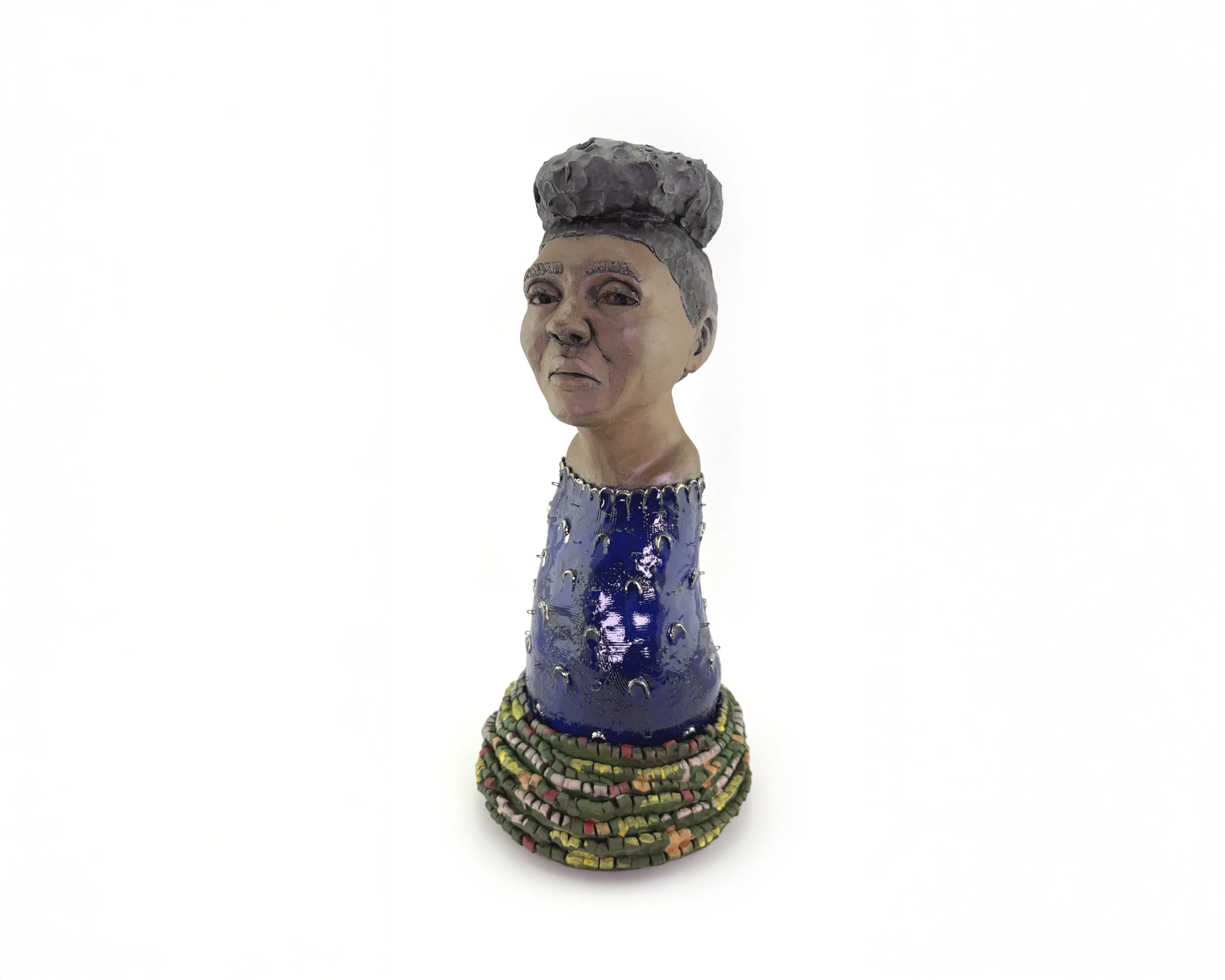
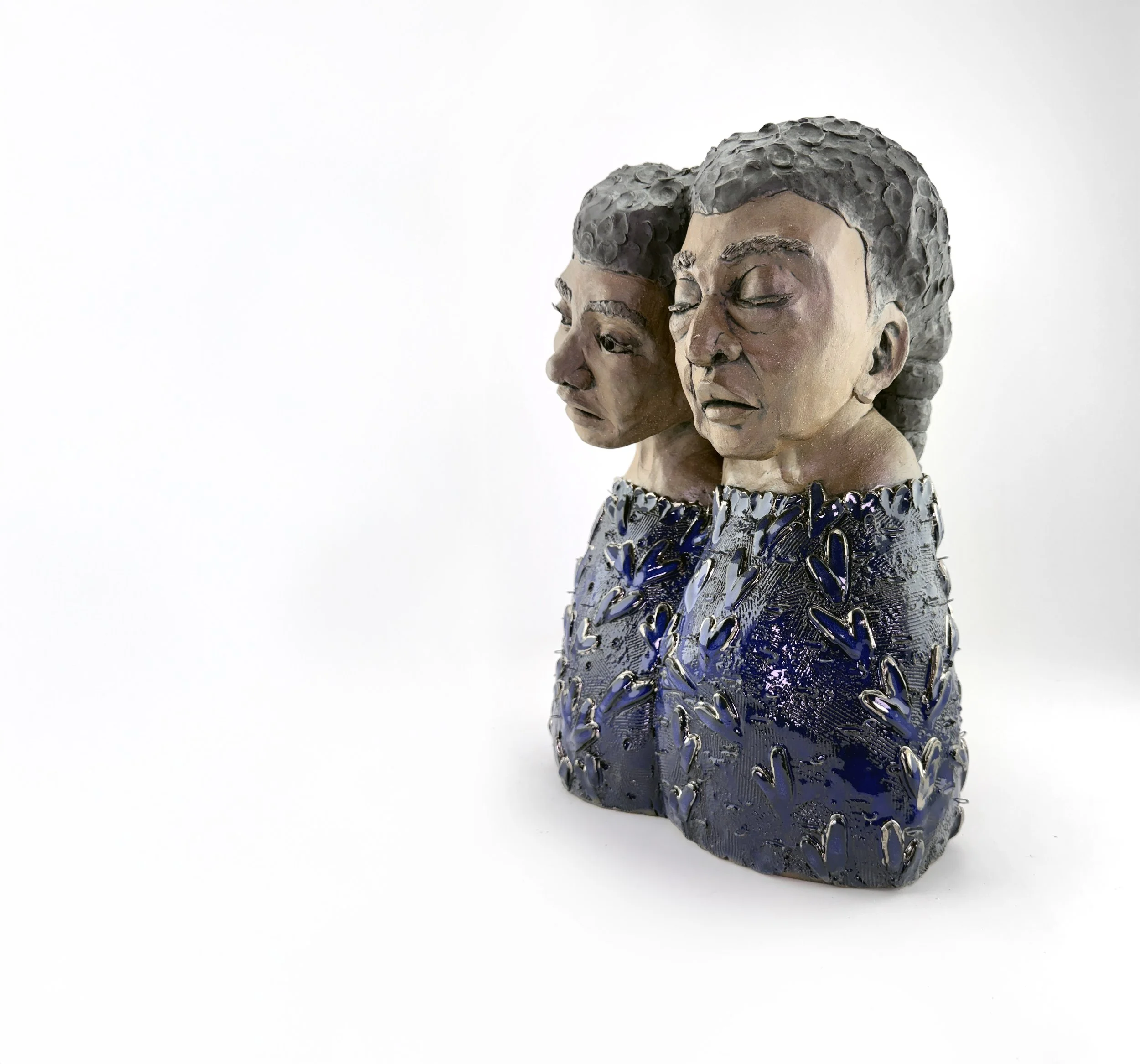
Quinn Alexandria Hunter is a sculptor and performance artist who works primarily with hair and the African American female body as material. She was born and raised in Charlotte, North Carolina, and did her MFA work at Ohio University. Recipient of the I. Hollis Parry/Ann Parry Billman Award (2019), Quinn has exhibited and performed nationally. She is interested in the erasure of history from spaces, and how the contemporary uses of space impacts the way we, as a culture, see the past.
Her practice revolves around uncovering and unveiling truths. Digging into the histories of African Americans to find spaces and memories that have been lost, erased, or covered. With that information, she makes work that references specific spaces in the area to bring forth information that has been lost to time and erasure. Contending with erasure of Black bodies from historic and contemporary spaces, Hunter looks at the way erasure of historic labor is connected to the contemporary and how it affects space around us. The erasing of labor renders bodies, the spaces they work in, and the work itself, invisible. This erasure of labor is amplified in the labor done by women of color, in particular, the labor done by African American women in contemporary and historic domestic spaces. Through the use of her own labor and material resistance, she is combating and interrupting erasure by reinscribing the erased labor of historic African American women and allowing their work to be remembered through her own contemporary labor.
-
BIOGRAPHY
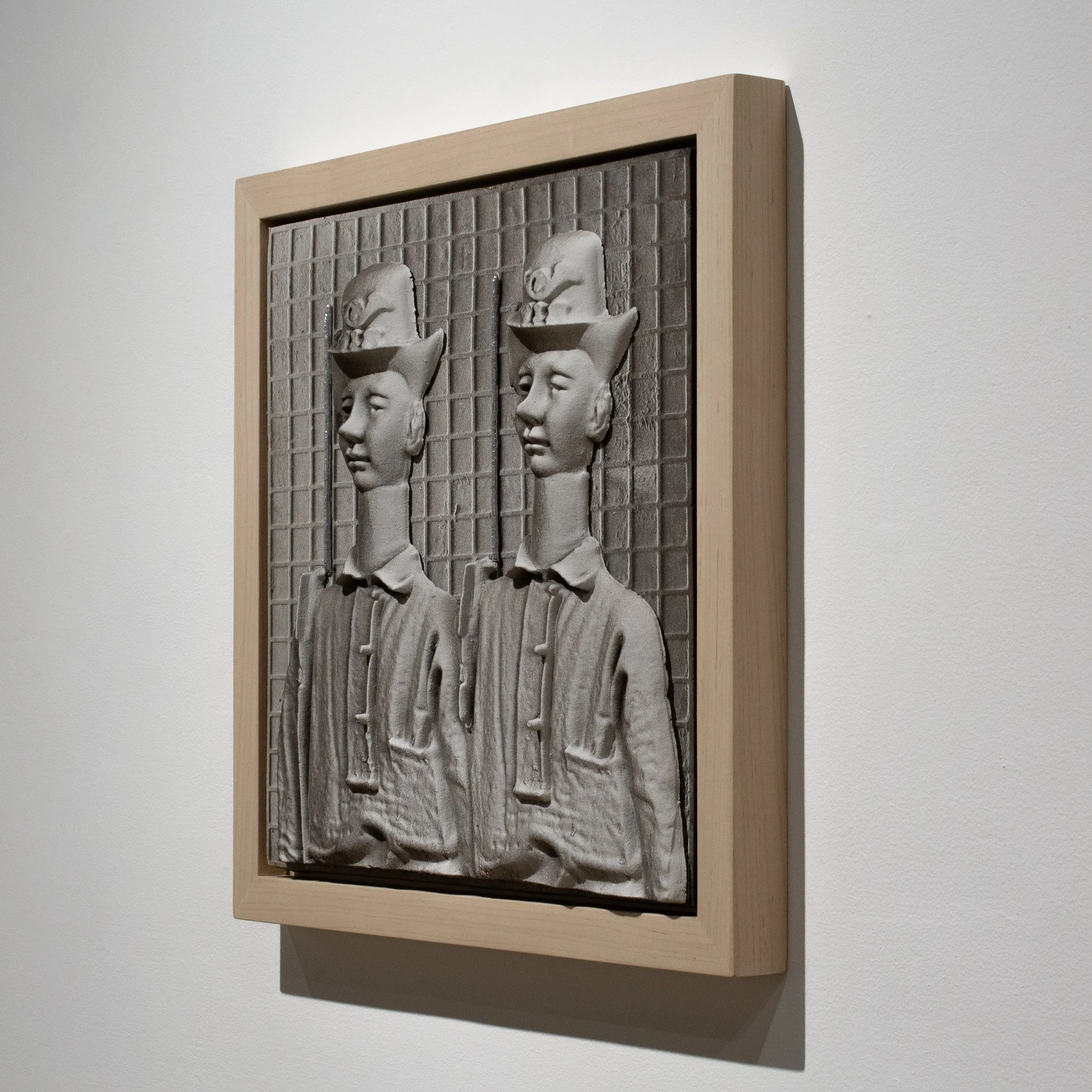
Bri Murphy is an interdisciplinary artist working at the intersection of digital fabrication and traditional sculpture and ceramic practices. Their work explores American identity through the deconstruction of national mythologies and is deeply informed by material investigation, history, and the power of objects to hold meaning and memory. Murphy holds an MFA in Ceramics from Ohio University and bachelor’s degrees from SUNY New Paltz. They are based in Greeley, Colorado, and are Assistant Professor of Sculpture and Digital Fabrication at the University of Northern Colorado.
ARTIST STATEMENT
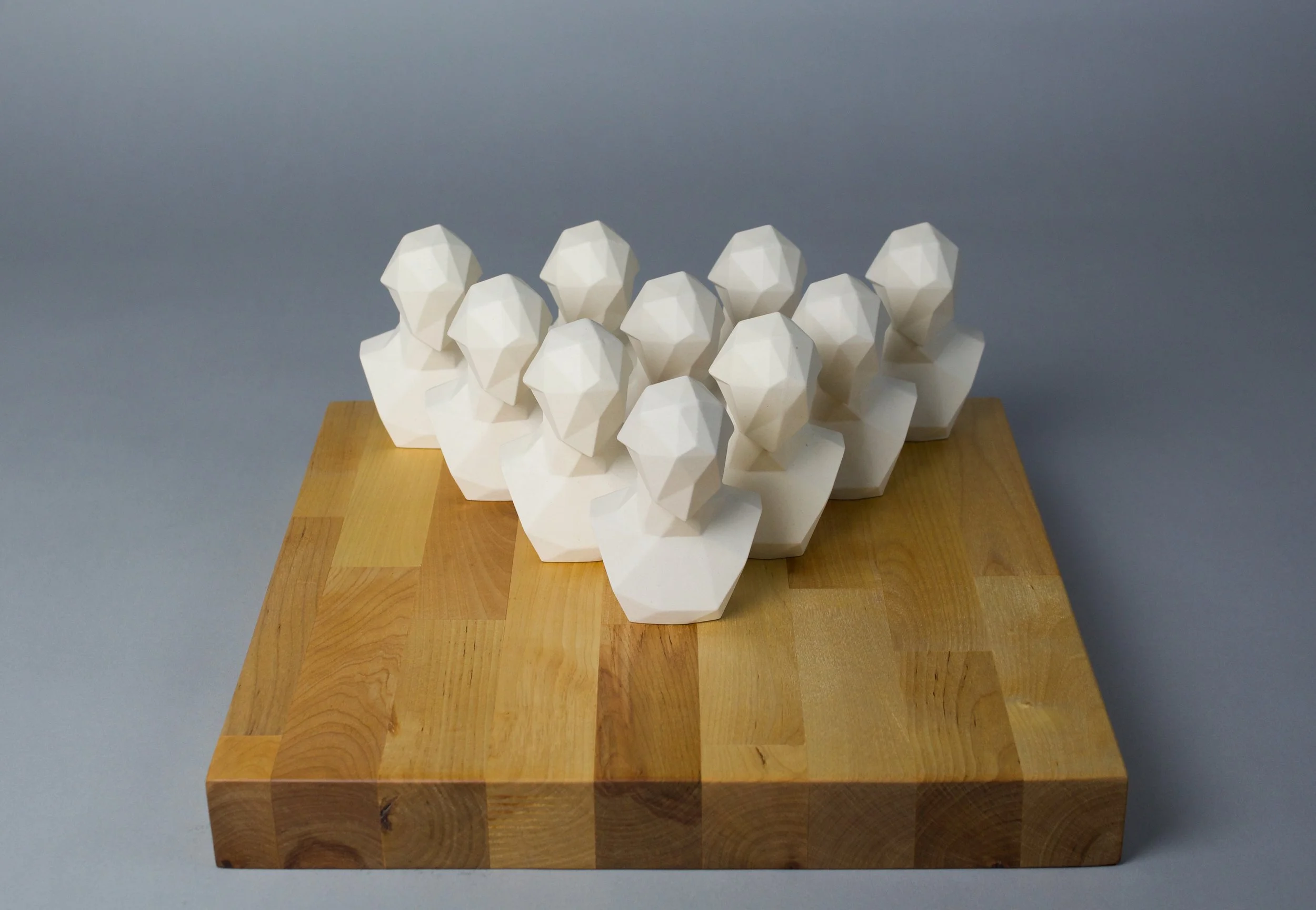
My work is an ongoing exploration of the contrasting and often conflicting narratives that shape American identity. Grounded in historical research, my practice examines the interconnected ways that material, economy, and culture influence one another. A deep appreciation for traditional craft exists alongside a fascination with digital tools and processes - a relationship that mirrors contemporary anxieties about technology’s role in both preserving and destabilizing cultural memory. I am motivated by working between analog and digital methodologies, and believe that this hybridity creates bridges across time, material, and audience.
Central to my practice is a desire to hold the tensions of the present against the mythologized narratives of the American past. In an era where cultural symbols are weaponized and competing versions of truth proliferate, I am drawn to the contradictions embedded in national identity: the simultaneous radicalism and exclusionary nature of the country's founding, and the assumptions about access, inheritance, and belonging that persist in its symbols. My work grapples with the cognitive dissonance many Americans experience - the negotiation between confronting a painful history and holding personal memories shaped by those same cultural myths. Through this, I aim to create spaces of resonance for viewers navigating similar questions of identity, memory, and nationhood.
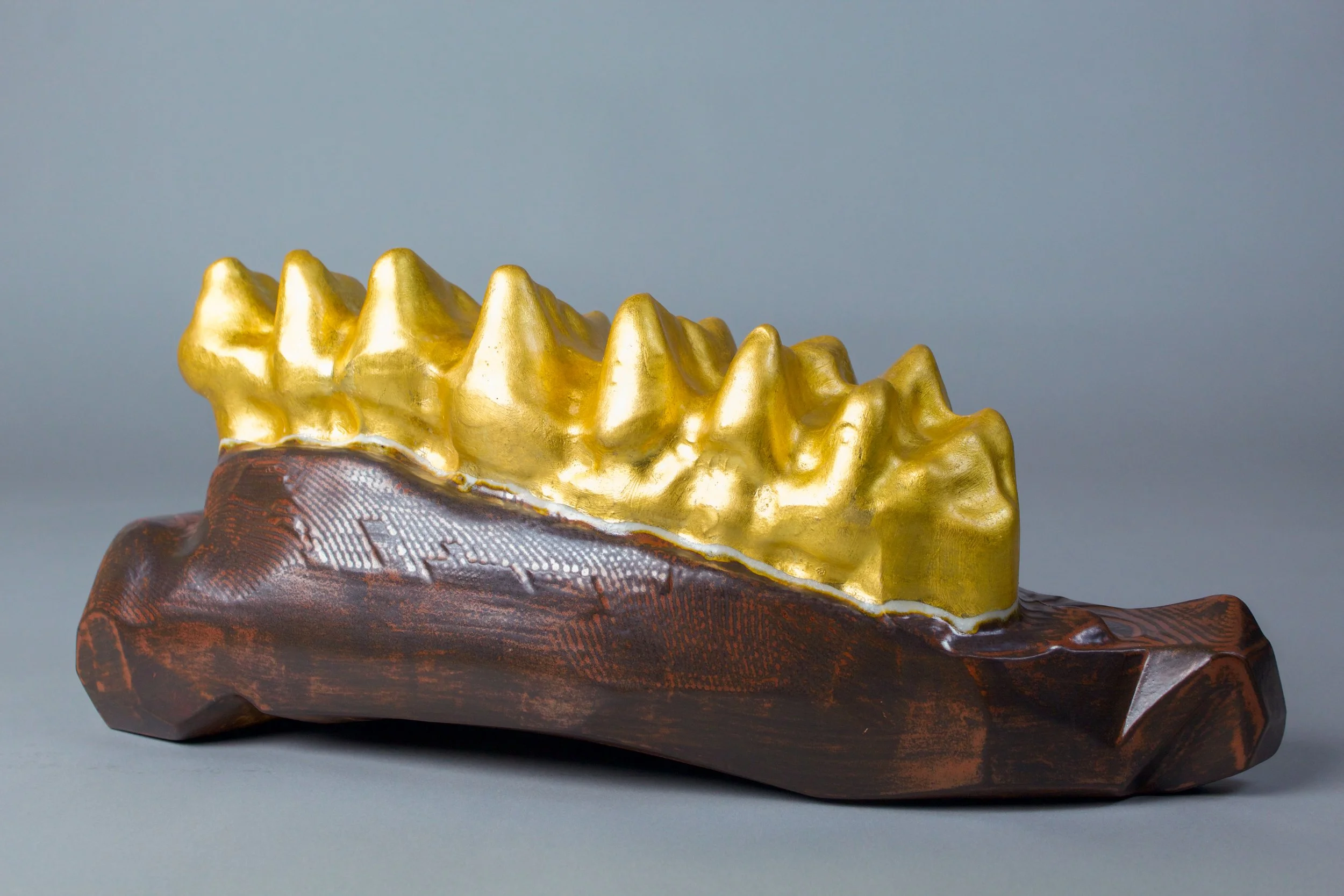
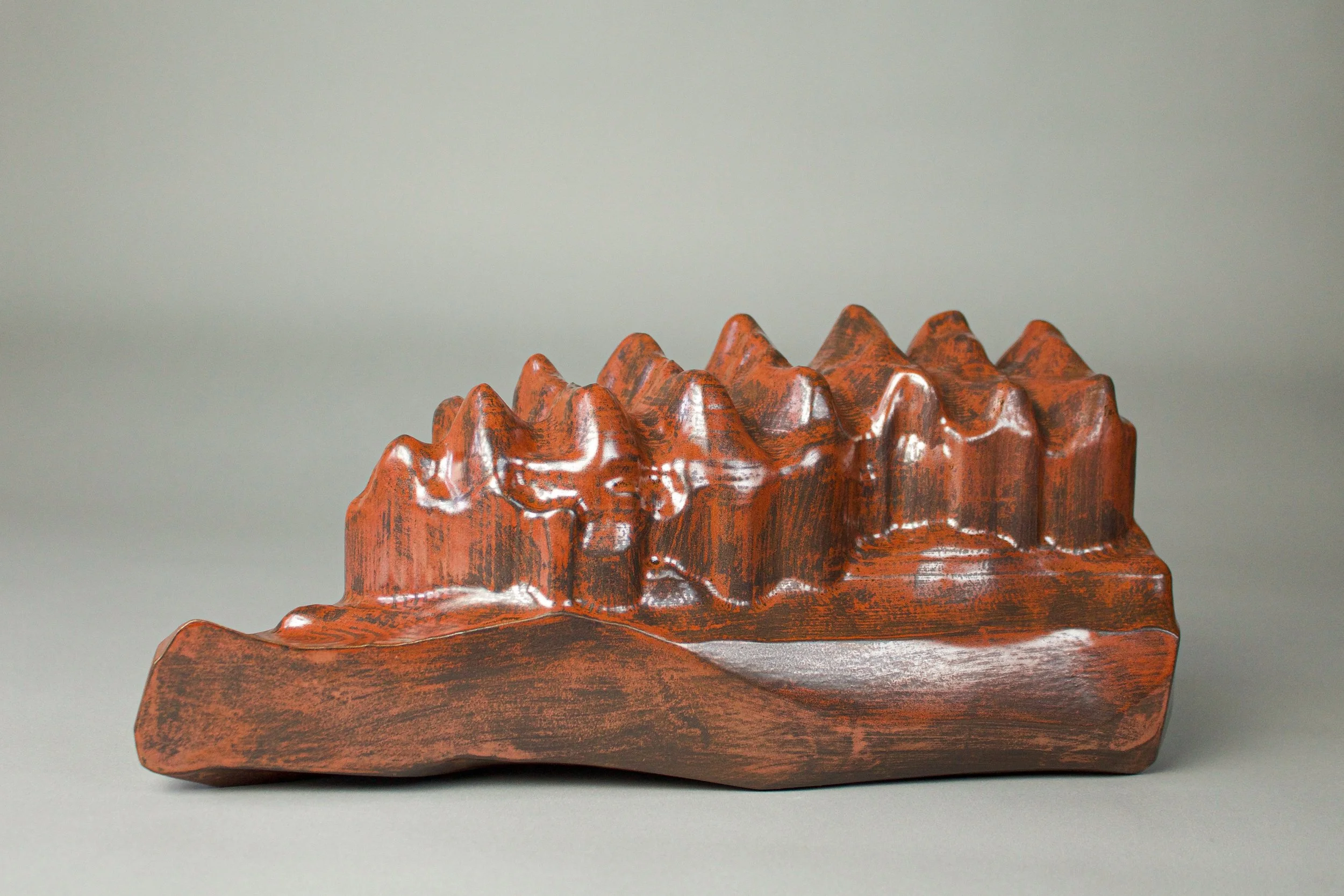
Work Statement for Sacred Remnant + Big Beautiful Grill
Mastodons have a long history of association with American Nationalism and Exceptionalism. Thomas Jefferson famously used the presence of mastodons and mammoths in America to counter an assault from the French naturalist, the Comte de Buffon, who wrote in American Degeneracy that the size of the animals of the new world were smaller than their European counterparts and therefore (obviously) inferior. Lewis and Clark hoped to find them roaming the West as their expedition laid the groundwork for Manifest Destiny. Mastodon specimens have been coveted since 1705, when the first fossilized molar was discovered in New York, and entire economies have been built on the excavation of these resting bones - which sell today at auction for hundreds of thousands of dollars. At the confluence of history, scientific inquiry, and wonder are these fossils - proof from a past age of greatness.
-
BIOGRAPHY
Joey Quiñones is a fiber artist, ceramicist, and mixed media sculptor. Their work focuses on African American and Caribbean history, specifically queer, Afro-Puerto Rican identity. They were selected as an Emerging Artist of 2020 by Ceramics Monthly, an Augusta Savage Grant recipient by the National Sculpture Society, and an Annual Prize Finalist by Manifest Gallery. Their work has been shown nationally and internationally at venues such as the Palais de Tokyo, Manifest Gallery, the Akron Art Museum, the Crocker Museum, the Shepherd, the Elaine L. Jacob Gallery, the Winterthur Museum, and The Sculpture Center. They have an MFA in Studio Art from Indiana University, Bloomington, and a Ph.D. in English from the University of Iowa. They have had residencies at Vermont Studio Center, the Winterthur Museum, Garden, and Library, and the Arts/Industry residency in Foundry at the John Michael Kohler Arts Center. They are currently the Artist-in-Residence/Head of the Fiber Department at Cranbrook Academy of Art in Bloomfield Hills, MI.
ARTIST STATEMENTAs an artist, I create mixed media sculptures that use textiles, ceramics, and found objects to highlight the constructed nature of racial, gender, and class identity. Through a dialogue between domestic items and historical research, especially of the 18th and 19th century, I aim to challenge notions of family, home, and belonging by foregrounding the enduring impact of enslavement across the U.S., Caribbean, and Americas. With fibers and clay as my conceptual anchors, I draw from the rich material lineages of West Africa, Spain, and the Americas to create objects that can carry memory, tension, and defiance. Domestic household items have a long history and rather than seeing them as innocent cultural markers, I want viewers to question how these prized and valuable commodities, handed down from generation to generation, are actually symbols for how the world is seen. Culturally they convey who matters socially, and who does not. By transforming objects to more accurately convey the human cost involved, I aim to have viewers question the historical legacy of colonization and enslavement. I aim to have viewers recognize how the past still lives on with us in the present as evidenced by our complex identities and social lives.
-
BIOGRAPHY
Lauren Sandler is a ceramic artist and educator based in Philadelphia. Her work examines the myriad chronicles told by objects as a means to explore stories that have been erased, distorted, and rewritten. Her recent work utilizes the vessel as an assemblage of parts, an accumulation of material culture to offer multiple perspectives. The work becomes a site to examine economies of power, migration and occupation, labor and commodification. Through this process disparate systems, forces, and ideologies converge as layered narratives combine in one form.
Sandler exhibits nationally, and gives talks, workshops, and publishes work concerning contemporary and historic issues in ceramics. She holds an MFA in Ceramics from Penn State University, and undergraduate degrees in Anthropology and Ceramics from Ithaca College and SUNY New Paltz. She served on the Board of The National Council on Education for the Ceramic Arts as Director at Large from 2019-2022 and is currently Associate Professor and Program Head of Ceramics at Tyler School of Art and Architecture at Temple University.
ARTIST STATEMENT
Centuripe Series
This series investigates historic and contemporary narratives of power and perspective through the familiarity of the vessel, assembled as stacked parts, embedded with an accumulation of cultural objects. The recognition of the vessel form serves as an entry point to challenge the presumptive neutrality of material, and asks the viewer to step closer to understand layers of context. These pieces consider the extraction and production of tea, sugar, coffee, salt, and other goods to examine economies of control that constitute migration, occupation, commodification, and labor. With discursive content, the objects signify the monumental and mundane, function and adornment, domestic and sacred across time and place.
-
BIOGRAPHY
Rose Schreiber (b. 1988) is a visual artist from Chicago, IL. Currently, she is Visiting Professor in Ceramic Art at Montana State University in Bozeman, MT. Through her artwork and research, Rose focuses on the intersection of ecological thought and ceramic art and materials--exploring issues of land, power, extraction, the planetary imaginary, and geologic poetics.
ARTIST STATEMENT
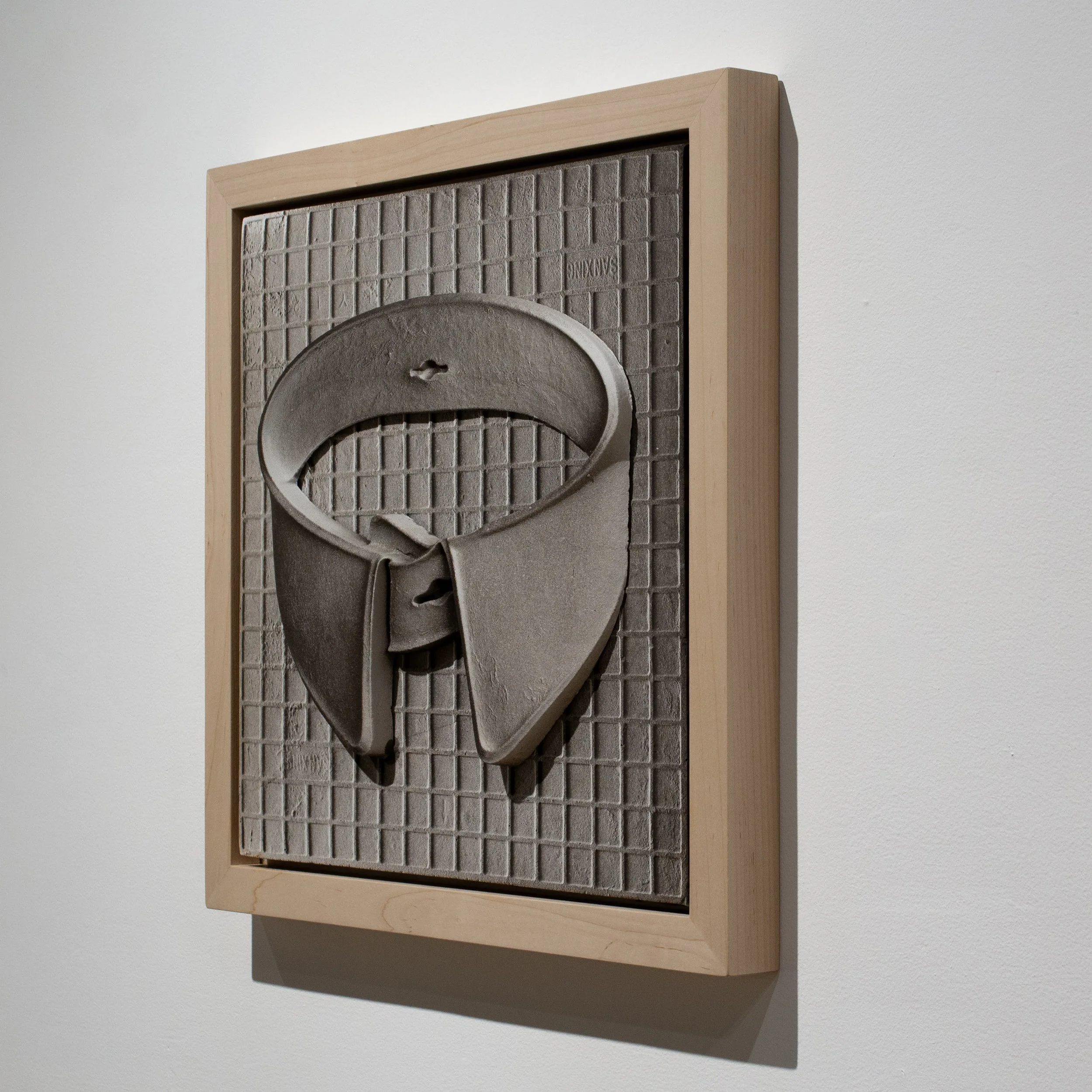
Since I arrived in Montana in August, 2024, I have been working on a project about yokes and collars as visual metaphors, with ties to labor, land, power, capitalism, and disparate energy regimes.
This project grew out of my fascination with the term “copper collar,” an early 20th century pejorative lodged at Montana politicians said to be in the pocket of big copper. It is hard to overstate the power and legacy of this industry in Montana, in the United States, and in other parts of the world. Spurred by the push for electrification, and aided by the invention of large-scale explosives, industrial copper mining in the 19th and 20th centuries helped inaugurate a new technological and environmental age. It also created a chain of wealth disparities and ecological disasters that stretched from Butte, Montana to Calama, Chile. Both Ayn Rand and Che Guevara, two cultural economic icons of the 20th century, saw in the Anaconda Copper Company an emblem of their political vision.
The breadth of meanings and relationships contained in this history is difficult to express in succinct terms. Needless to say, I was taken by this phrase—copper collar—and the ideas of labor, control, and power that a collar represents. It made me think about what the neck, and its artifacts, symbolize. I thought about the yoke, preeminent tool of a neck in submission, and the competing agricultural economies of western Montana. The yoke is the literal harnessing of the power of another and, along with the electrification of the copper collar, represents its own energetic regime. Through these symbols, I have been thinking about how constriction, enclosure, and economy are inscribed both on the body and on the land. The collar and the yoke, the fence and the razor wire: each is suggestive of degrees of freedom and unfreedom, possession and privation, movement and its impediment.
Boundaries, with their imagined contours, are a common theme in ecological thought and epistemology—a field premised on the lack of separation between things. When I visited the Center for PostNatural History in Pittsburgh, PA, I was struck by the way the center talked about captivity. Captivity—enclosure of the body—marks the onset of postnatural relations. This idea has stayed with me ever since.
My instinct is usually to remove as much of myself from my visual art, to stress my own narrative insignificance. But lately, through this project, I have been thinking about my own relationship to these things: my relationship to land, economy, labor. Particularly as a middle-class urbanite in the academic arts, so-called “freedom” of movement is expected of me, is considered a privilege and an “opportunity.” At the same time, as far as I can tell, there is no living memory in my family of a close tie to land and place. In many ways, this uprootedness is part of the legacy of cities, land enclosure, and privatization—itself a seminal moment in the development of capitalism.It is not lost on me that both the collar and the yoke are also spiritual symbols - signs of submission and obedience to a power. Each elicits a particular posture: a body erect, a body bending over. I say this not to romanticize these objects and symbols, but to underscore ambiguity, my own searching amidst uncertain signs.